Core Drilling Equipment: Types, Applications and Selection Criteria Meta Başlık
Core drilling equipment refers to the specialized tools used to extract cylindrical rock or soil samples from underground formations. These samples are called cores. Unlike ordinary drilling, the main purpose of core drilling is not only to make a hole in the ground, but to collect reliable information about the structure below the surface.
What Is Core Drilling Equipment?
Core drilling equipment refers to the specialized tools used to extract cylindrical rock or soil samples from underground formations. These samples are called cores. Unlike ordinary drilling, the main purpose of core drilling is not only to make a hole in the ground, but to collect reliable information about the structure below the surface.
For this reason, core drilling is widely used in mineral exploration, geological research, geotechnical investigations, dam projects, tunnel works, road construction, bridge foundations and large infrastructure projects. The recovered core samples help engineers and geologists understand rock type, fracture structure, mineral content, strength properties and layer transitions.
In field conditions, one thing is very clear: a powerful drilling rig alone is not enough. If the equipment used at the end of the system is not suitable for the formation, the expected performance cannot be achieved. In core drilling, the core barrel, diamond bit, drill rods, reamer, casing pipes and flushing system must work together properly. Otherwise, sample quality decreases, penetration slows down and operational costs increase.
Why Is Core Drilling Important?
Core drilling is one of the most reliable methods for obtaining direct information from underground formations. It does not simply create a borehole; it allows the recovery of physical samples that can be examined, measured and tested.
In mining projects, core samples provide information about the quality, continuity and economic potential of a mineral reserve. In geotechnical investigations, they help determine whether the ground is suitable for a structure. In dam, tunnel and major infrastructure projects, core drilling reduces uncertainty and supports safer technical decisions.
The main advantages of core drilling include:
- Direct examination of underground layers
- Recovery of rock and soil samples
- Technical data for mineral exploration
- Analysis of strength and fracture structure
- Clear observation of geological transitions
- Reduced project risk before construction
- Reliable samples for laboratory testing
This is why the quality of core drilling equipment matters not only for field performance, but also for the reliability of the data obtained.
Main Equipment Used in Core Drilling
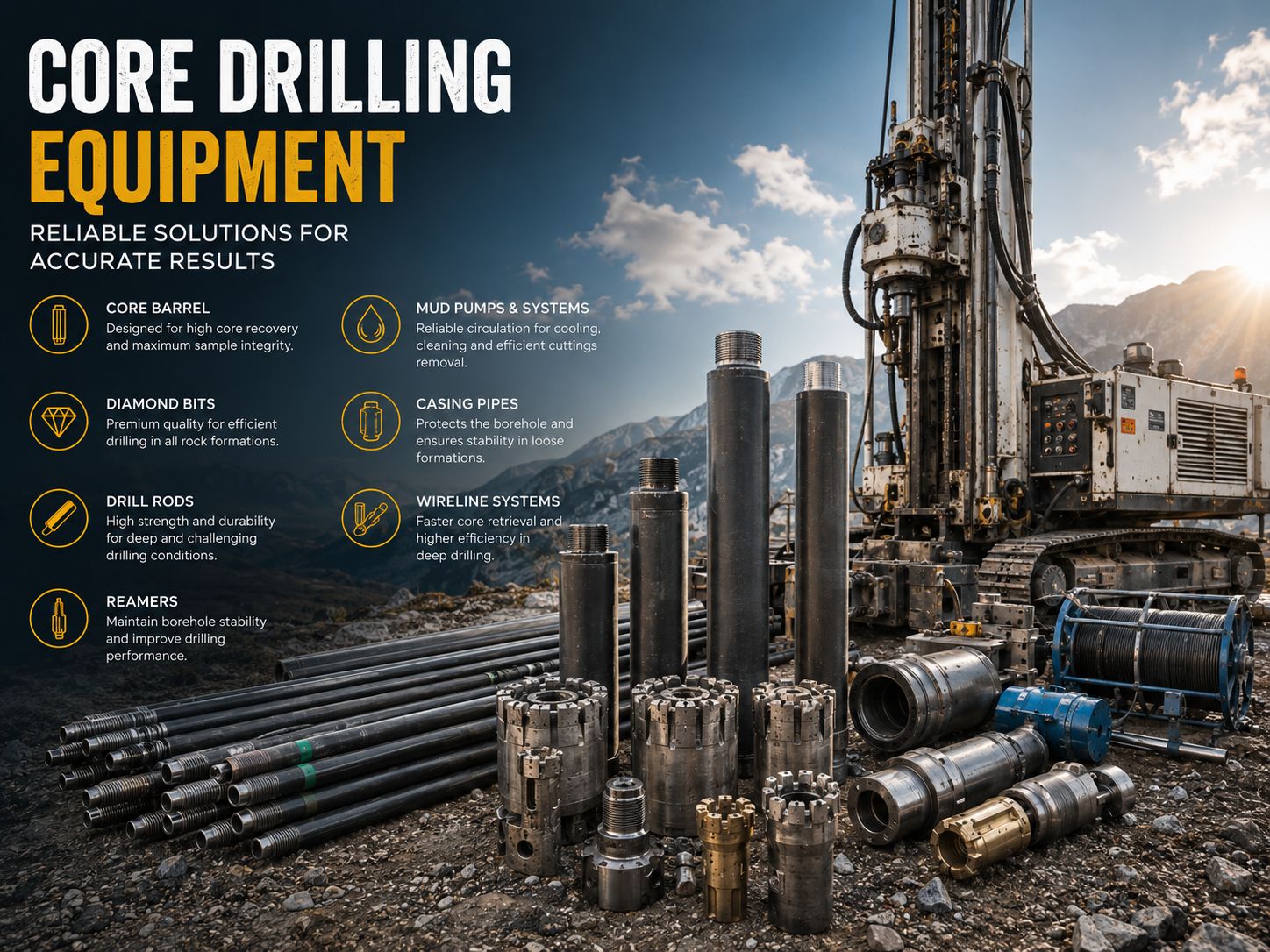
Core drilling is a system where several components work together. A single high-quality part is not enough on its own. The core barrel, bit, rods, casing, pump and auxiliary components must be compatible with one another.
Core Barrel
The core barrel is one of the most important pieces of equipment in core drilling. It is the part that allows the cylindrical sample to be collected from underground. The core barrel receives the cut rock or soil sample and helps bring it to the surface with minimum disturbance.
When choosing a core barrel, diameter, length, system type and formation conditions must be considered. The core barrel used in hard and fractured rock may not be the same as the one preferred in softer formations.
The main functions of a core barrel are:
- Collecting the core sample
- Protecting the sample during recovery
- Working in harmony with the bit and drill rods
- Reducing sample loss
- Helping obtain cleaner and measurable core
If the core barrel quality is poor, the sample may break apart, core recovery may decrease or jamming may occur during the operation. This results in both time loss and technical data loss.
Diamond Bit
The diamond bit is one of the most critical cutting components in core drilling. Its cutting surface contains natural or synthetic diamond particles. This structure allows controlled and efficient cutting in hard rock formations.
Diamond bit selection should be made according to the rock structure at the site. If the wrong bit is used in hard, abrasive or fractured formations, penetration rate may decrease and the bit may wear out quickly. A properly selected diamond bit improves sample quality and makes the drilling process more economical.
Important points in diamond bit selection include:
- Rock hardness
- Abrasiveness of the formation
- Drilling depth
- Bit diameter
- Rotation speed
- Weight on bit
- Water or mud circulation
- Compatibility with the core barrel system
In drilling, the most expensive tool is not always the best choice. The right tool is the one that matches the ground conditions and working method.
Drill Rod
The drill rod transfers rotation and pressure from the drilling rig to the bit and core barrel system. Although it may look simple, drill rod quality is highly important in core drilling. Rods are exposed to torque, vibration, pressure and continuous mechanical stress.
If low-quality or unsuitable rods are used, connection problems, bending, breakage or thread wear may occur. In deep drilling operations, rod strength and connection quality are critical for operational safety.
Important features of drill rods include:
- Material quality
- Thread design
- Connection compatibility
- Resistance to bending
- Torque capacity
- Diameter and length standard
- Corrosion resistance
The stronger the drill rod system, the more efficiently power is transferred from the rig to the cutting end.
Reamer
A reamer helps maintain the borehole diameter and keeps the hole stable during drilling. In core drilling, it is usually used near the bit or within the appropriate part of the core barrel system.
Reamers are especially useful in fractured, abrasive or unstable formations. They help prevent the hole from narrowing and reduce the risk of the core barrel becoming stuck.
Correct reamer use helps:
- Maintain borehole diameter
- Reduce sticking risk
- Create a smoother borehole
- Stabilize the bit and core barrel system
- Improve operational efficiency
Casing Pipe
Casing pipe is used to protect the borehole and prevent collapse. It becomes especially important in loose, broken or water-bearing formations.
In some ground conditions, the borehole can remain stable without support. In others, collapse, narrowing or wall failure may occur. In such cases, casing pipes are used to keep the borehole safe and open.
Casing pipes are used to:
- Prevent borehole collapse
- Provide stability in loose formations
- Protect the drilling line
- Support controlled circulation
- Improve operational safety
In deep and challenging drilling projects, casing selection can directly affect the success of the operation.
Mud Pump and Circulation System
Core drilling is not only a mechanical cutting process. The cuttings must be removed from the borehole, the bit must be cooled and the system must operate smoothly. This is done through water, drilling mud or another suitable drilling fluid.
The mud pump sends drilling fluid into the system and helps carry cuttings away from the bit area. It also prevents overheating. If circulation is not sufficient, bit life decreases, sample quality suffers and the risk of jamming increases.
The circulation system helps:
- Cool the diamond bit
- Carry cuttings to the surface
- Keep the borehole clean
- Extend bit life
- Improve drilling performance
- Reduce overheating and sticking risks
For this reason, pumps and circulation systems should be considered an essential part of core drilling equipment.
Wireline Systems
Wireline systems are especially useful in deep core drilling operations. With this system, the entire drill string does not need to be removed every time a sample is recovered. Instead, the inner tube is retrieved using a special mechanism.
Wireline systems save considerable time in deep drilling. They also make the operation more organized and controlled. They are widely used in mineral exploration and geological research projects.
Advantages of wireline systems include:
- Faster sample recovery
- Less need to remove drill rods
- Higher efficiency in deep drilling
- Reduced operation time
- Easier sample tracking
As drilling depth increases, the advantage of wireline systems becomes even more noticeable.
Where Is Core Drilling Equipment Used?
Core drilling equipment is used in many industries. Although each industry has different needs, the common goal is to obtain reliable underground data.
Mineral Exploration
Core drilling equipment is one of the most commonly used systems in mineral exploration. Core samples help determine mineralization, ore quality, vein continuity and economic value.
In mining sites, proper equipment affects not only drilling speed but also sample quality. If the core sample is damaged or incomplete, laboratory analysis may not provide reliable results.
Geotechnical Investigation
In geotechnical projects, core drilling is used to understand ground strength and rock structure. This information is essential for large buildings, bridges, dams, tunnels and industrial facilities.
Core samples allow engineers to evaluate strength, fractures, groundwater conditions and layer transitions. These details are valuable for foundation design and project safety.
Geological Research
In geological research, core drilling provides detailed information about underground formations. Layer sequence, rock types, faults and fracture systems can be examined through recovered core samples.
These studies are used in scientific research, energy projects, infrastructure planning and risk analysis.
Dam, Tunnel and Infrastructure Projects
In dam, tunnel, road, viaduct and large infrastructure projects, core drilling is one of the most important investigation methods before construction. Ground risks can directly affect both safety and project cost.
A properly recovered core sample helps identify potential ground problems before construction begins.
How to Choose Core Drilling Equipment
Core drilling equipment should not be selected based only on price. Ground conditions, target depth, expected sample quality and drilling rig compatibility must all be evaluated together.
Ground and Rock Structure
The first criterion is the formation type. Hard, soft, fractured, abrasive or water-bearing formations require different equipment. Diamond bit and core barrel selection should be made according to the actual ground conditions.
Target Depth
As drilling depth increases, equipment quality becomes more important. Equipment failure or bit replacement in deep drilling can cause serious delays. Durable and compatible equipment should be preferred for deep projects.
Sample Quality
In core drilling, the goal is not only to advance. The recovered sample must be clean, measurable and suitable for analysis. Equipment that reduces sample loss and improves core recovery should be preferred.
System Compatibility
The core barrel, drill rods, bit, reamer and pump system must be compatible. If sizes, connections or working principles do not match, field performance decreases and equipment life becomes shorter.
Equipment Quality
High-quality equipment may look more costly at first, but it often reduces downtime, improves penetration, protects sample quality and lowers total operational cost.
Common Mistakes in Core Drilling
Core drilling requires experience. Wrong equipment selection or incorrect operation can seriously reduce project efficiency.
Common field mistakes include:
- Using a diamond bit that is not suitable for the formation
- Insufficient circulation
- Applying too much pressure
- Continuing to use worn equipment
- Not checking rod connections regularly
- Choosing the wrong core barrel system
- Ignoring borehole cleaning
- Poor sample tracking
These mistakes may look small, but in deep and difficult drilling sites they can lead to serious cost increases.
Why Quality Matters in Core Drilling Equipment
In core drilling, quality does not only mean durability. Quality equipment provides stable drilling, better sample recovery, lower failure risk and more efficient field performance.
With quality core drilling equipment:
- Core samples are recovered more cleanly
- Penetration becomes more stable
- Bit and rod life improves
- The rig works under less stress
- Sticking risk is reduced
- Borehole quality is maintained
- Total operational cost decreases
In drilling, the biggest loss is sometimes not the price paid for equipment, but the time lost on site. This is why proper equipment selection creates long-term value.
Conclusion
Core drilling equipment is used to obtain reliable underground samples and analyze formations accurately. Core barrels, diamond bits, drill rods, reamers, casing pipes, mud pumps and wireline systems are the main components of this process.
For a successful core drilling operation, equipment must be high-quality, compatible and suitable for site conditions. Wrong equipment selection slows down drilling, reduces sample quality and increases costs.
The right core drilling equipment provides more efficient operation, healthier samples and more reliable technical data. For this reason, equipment selection in core drilling is not just a purchasing decision; it is a technical decision that directly affects project success.